
Frequently Asked Questions
Below you will find answers to our most frequently asked questions. However, if you have a question of your own, please do not hesitate to get in touch.

-
Hexigone’s ‘on-demand’ corrosion inhibitor contains an organic cation held in a cation exchange resin. When an electrolyte is present in a corrosive environment, cations are sequestered by the cation exchange resin which releases the ‘active ingredient’ into the electrolyte where it is deprotonated and will then turn into its anionic form. The azole group at one end forms a bond with the metallic surface and metallic ions released at the anodic dissolution. A precipitate is then formed by the reaction of ‘active ingredient’ anions with metal cations to form an inhibitive film which prevents corrosion.
-
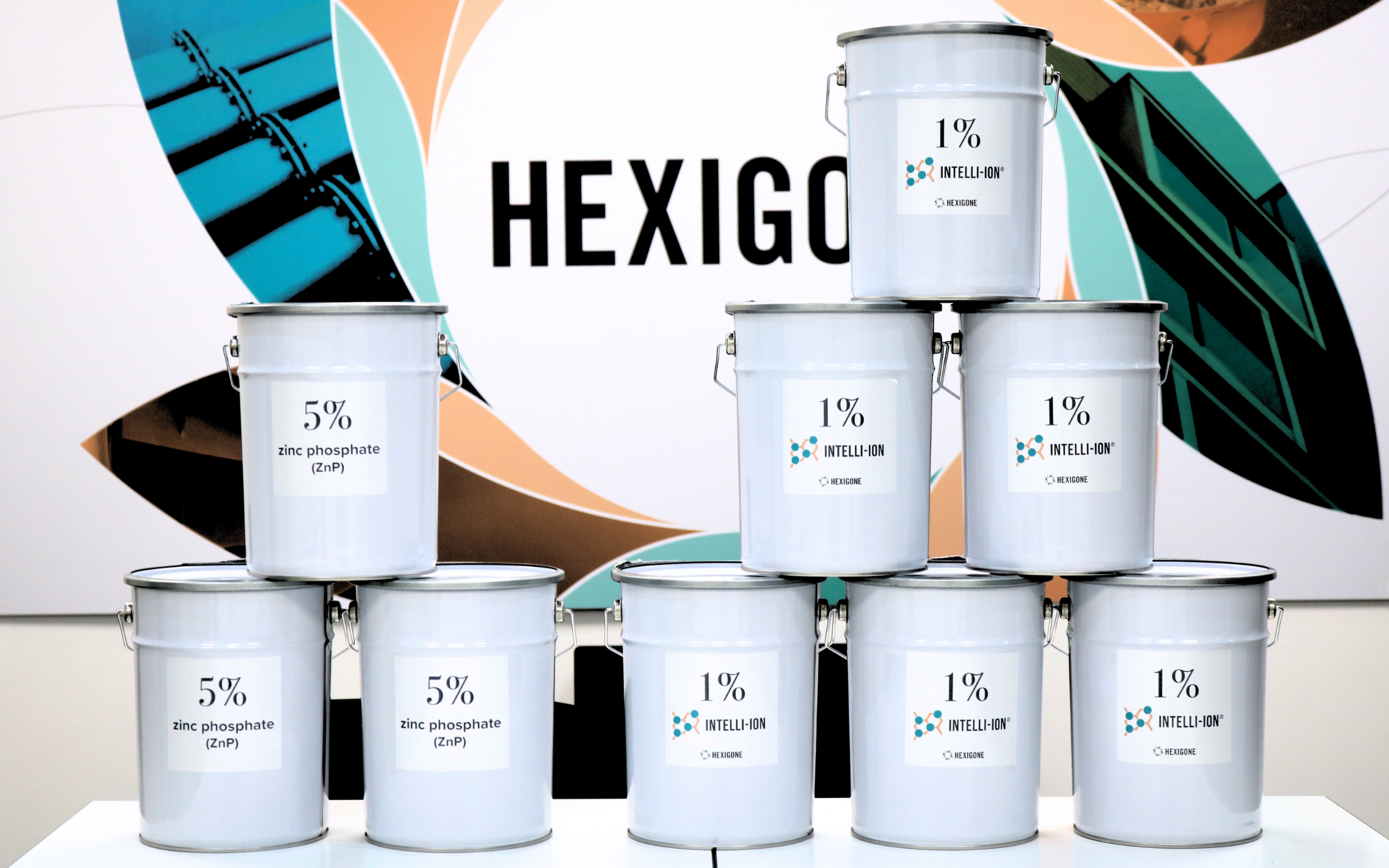
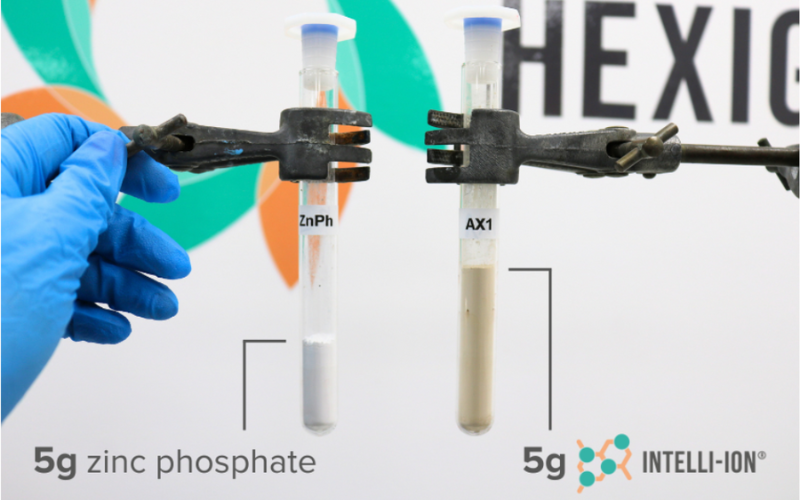
No! A common misconception is that Intelli-ion® AX1 is a “like for like” replacement for zinc phosphate. In reality, AX1 is a completely different material—featuring a unique hollow structure and huge surface area.
With a larger surface area Intelli-ion® AX1 has distinct advantages:
Increased active sites means it’s more effective at blocking corrosive agents
It coats and protects the substrate surface more thoroughly, reducing active corrosion sites
Its “on-demand” response protects rapidly
That is why we highly recommend starting at 0.5% & 1% AX1
Cost effective, maximum corrosion protection at minimal loadings.
-
Yes, Intelli-ion® AX1 + phosphate has been successfully validated across several systems and applications. When used in conjunction with zinc phosphate for example, AX1’s active ingredient quickly releases and protects from damage via the nano layer formation, which then allows zinc phosphate time to dissolve in any electrolyte and form a layer in combination with the active ingredient.
-
Whilst the cost per kilo of Intelli-ion® AX1 is higher than zinc phosphate, AX1’s low specific gravity (~1.35) delivers more usable volume per unit weight and effective protection at low loadings.
Because Intelli-ion® works at significantly lower loadings, when you purchase the same amount of inhibitor, you can produce twice the paint volume.
Click »here« to find out more.
-
The Intelli-ion® products impart lone-pair bonding between the primer and the substrate, also the primer and subsequent coating layers. This increases the adhesion by changing the bonds from H-bonds to stronger covalent bonds.
-
Metal substrates – across a range of ferrous and non-ferrous - including steel, aluminium, aluminium 2024, aluminium 2014, magnesium, galvalume, and HDG materials.
-
The Intelli-ion® range does not contain any metals or chromates. Our high performing inhibitors are designed to replace chromates and heavy metals in coatings.
-
The products in Intelli-ion® AX1 contain a mixture of different compounds held together and do not contain any heavy metals or chromates. They are differentiated by their active inhibitor or pH. These inhibitors are not encapsulated but are chemically triggered to release from the active sites when corrosion ions are detected. The inhibitor works at the cut-edge, defects in the coating and at the coating/metal interface.
-
Zinc phosphate salts on their own are not initially very effective due mainly to their low solubility. As a result, in a corrosive environment, significant amounts of time must pass before there are sufficient concentrations of phosphate anions to react with the metal cations to form an anti-corrosive precipitative layer. This leads to a time delay where corrosion can proceed unimpeded. Intelli-ion - because of its very fast formation of an inhibitive layer - acts in synergy with zinc phosphate by reducing corrosion occurring due to this time delay. AX1 provides the initial protection backed up by the zinc phosphate precipitate layer to provide a synergistic anti corrosion solution.
-
The technology does not have an outer shell containing the inhibitor inside. The system is a multi-branched long chain of active sites that hold onto the inhibitor until it is trigger released in response to corrosion.
-
Yes, typical ranges are from 7μm to 75μm. The reservoirs are long chains with active sites that can be ground down to nano sizes without inhibiting performance. There is no encapsulation or risk of leaching of the active ingredient.
-
The Intelli-ion® inhibitor systems are not phosphate based and are unique within the market. The system has been tested in conjunction with phosphate based systems where it is shown that the AX1 product range boosts the protection performance of phosphate based systems. Our products have been used to increase performance over phosphate based systems such as zinc phosphate, with a lower loading of the Intelli-ion® required.
-
Our inhibitor is completely different to any other inhibitor on the market. The components are organic and can be acidic or alkaline in nature. The ‘sense and release’ mechanism is unique, and we are not an encapsulated product so ultra-fine particle sizes and grinding does not affect the performance.
-
Our pigments utilise a system where they stay dormant in the coating system, until there is a chemical response from corrosion activities, which triggers the release of the inhibitor. Unlike the more traditional chemicals used, the inhibitor will only be released when it is needed.
-
The products can be ground down to any size without any effect on performance. The products are not encapsulated and are not triggered by physical damage. The products have been ground into nano particles with no effect on the protective performance.
-
Smart coatings are coatings that are functional and responsive to the environment they are in - the coatings actively protect themselves when they need to. By utilising additives, we can functionalise systems to perform different tasks. The Hexigone pigments allow environmental sensing and self-protection, which leads to a longer service life.
-
AX1 EF can be used in tie coat and top-coat developments- principally for DTM (Direct to Metal) products.
We recommend low loading levels - circa 1.5% or less by weight - which gives good anti-corrosive performance without compromising the integrity of the coating film. Co blends are typically advised for DTMs (Direct to Metal).
-
The smart-release pigments have allowed us to incorporate an inhibitor that was previously incompatible with coatings, resulting in a unique protection mechanism that is highly effective and quick to respond. The pigments have a cure enhancing component as well, resulting in better integral coatings, with high corrosion inhibition.
-
Intelli-ion®’s manufacturing process adheres to a circular economy approach, not only recycling virtually all raw materials used within production, but also utilising waste streams from an adjacent industry comprising up to 63% of its product.
Hexigone’s HQ and production facility was designed with energy efficiency in mind, achieving an A Rated Energy Performance with our energy needs being supplemented by a solar PV system.
We are also in the process of achieving an Ecovadis sustainability rating.
-
All Hexigone products are REACH compliant.
-
Intelli-ion® AX1 is 37% ‘active ingredient’, which is a Category 2 Hazard. The other 63% of AX1 EF is the smart reservoir system which has no safety warning requirements.
The chemically inert smart reservoir is derived from a separate process waste stream which makes the AX1 product 63% recycled which is a major circular economy benefit!
AX1 as manufactured and delivered is a Category 2 Hazard as the ‘active ingredient’ content is over the 25%. However, because the final primer formulation will only have 2-10% of AX1, this falls below the threshold of 25%, taking it to a Hazard Category 3 (H412) which means that there is no Hazard labelling requirement for the primer.
Zinc phosphate is classified H410 which is Aquatic Chronic Class 1. If this product is below 25% in a paint, it will move to a Classification 2 (H411) as the risk is lowered. However, Class 2 is still required to have a hazard warning label.
At loadings of less than 2.5% by weight in a paint – which can be achieved by cross blending AX1 with ZnP – the zinc phosphate level goes to a classification Category 3 (H412) and does not require a hazard warning label.
The best ratio for AX1 and zinc phosphate in a primer is 3:2. The conversion loading requirement can be calculated from our loading calculator spreadsheet. As the spreadsheet shows, all complete replacement and hybrid formulas in this conversion program are hazard warning label free.
-
Hexigone encourages formulation testing and offers bespoke technical advice based on the performance, cost, environmental credentials and other parameters you require for your product.
Prospective customers can order a sample via Hexigone or their their local distributor.
Sample bags are 250g.
-
20 kilos -250-gram sample bags are available.
Intelli-ion® additives are distributed in 20kg bags and 1,000kg pallets
Our manufacturing / export team ensure that the strictest environmental and export requirements are met for shipping across the globe.
-
Intelli-ion® additives are distributed in 20kg bags and 1,000kg pallets
Our manufacturing / export team ensure that the strictest environmental and export requirements are met for shipping across the globe.
-
As trials are successful our sales and technical team will be there to help best meet your needs through a commercial order. However ahead of this you don't need to pay anything - we cover the courier service and of course the cost of samples themselves.
If you have any other queries, please do not hesitate to get in touch with our team, who will be happy to assist.